Honest estimates · GA at launch

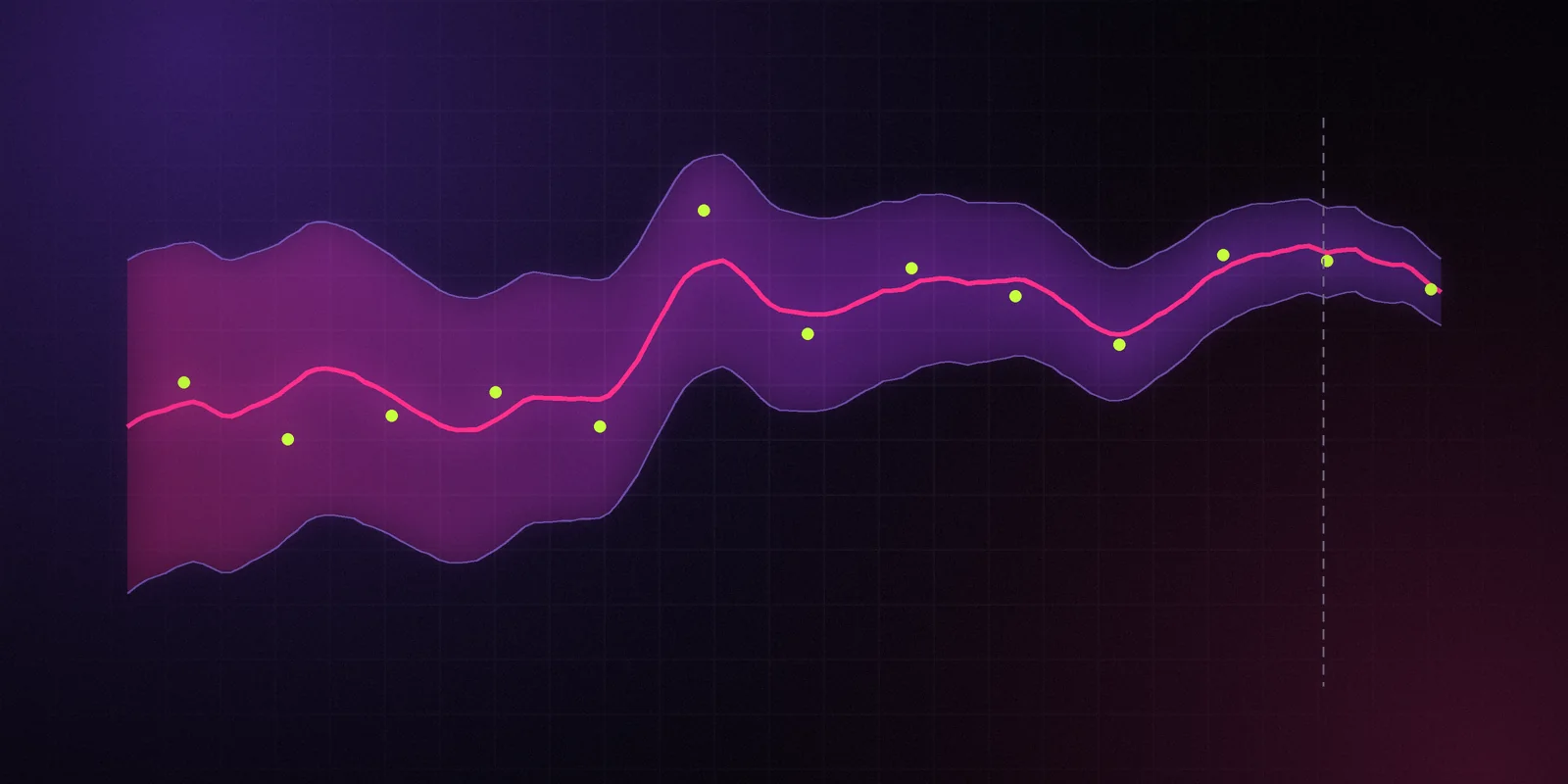
Every estimate has a range. Ours admit it.

App intelligence that shows its work: a range, a grade, a method version and a source on every number. Plus a monthly bulletin that checks us against real data.

Most app-intelligence tools give you one number. We give you three, plus a grade, plus the receipts. Every download, revenue and ad-spend figure on DataPussy is labeled "Estimate — modeled", because that's what it is. It doesn't come from Apple, Google or the publisher.

The Shape of an Estimate

An estimate is an object, not a scalar. You get the same fields in the dashboard, the API, the MCP server, webhooks and exports.

Example — illustrative, not real data:

{
  "metric": "downloads_30d",
  "p10": 40000,
  "p50": 55000,
  "p90": 76000,
  "grade": "B",
  "kind": "modeled",
  "label": "Estimate — modeled",
  "method_version": "v0",
  "inputs_used": ["top_free_rank", "category_curve", "review_velocity"],
  "provisional": false,
  "lower_bound": false,
  "suppressed": false,
  "as_of": "2026-11-01"
}
  • p10, p50, p90 — the band and its middle. There's roughly a 10% chance the real value is below P10 and a 10% chance it's above P90.
  • grade — A to D. How far to trust the band.
  • kind — observed, modeled or verified.
  • method_version — which version of the methodology produced this number.
  • inputs_used — the signals that went in. Fewer inputs, wider band, lower grade.
  • provisional — true for the last 72 hours, which can still move.
  • lower_bound — true when we can only see part of the total, such as revenue earned on the web.
  • suppressed — true when we hide the point estimate.
  • as_of — the date the estimate describes.

p10 and p90 are in every view, including the concise one your agent reads. Ranges don't get dropped to save tokens.

What We Won't Show

No point estimate below roughly 10k downloads or roughly $10k a month. Small numbers are where models are most wrong.
No point estimate for apps published by individual people. Seller name only, no contact details, pages not indexed.
No final number for the last 72 hours. Those days are flagged provisional.
No "total revenue" when part of it happens on the web. Web revenue is a lower bound and flagged that way.
No app's own private data in its public estimate without the developer's consent to display it.

How We Check Ourselves

Ground truth comes from two places: developers who connect RevenueCat or Stripe through Claim your app, and partner apps that get free access in exchange for sharing real figures. We test leave-one-out: an app's public estimate is never built from its own private data unless the developer agrees to show it.

Once a month we publish an accuracy bulletin. It reports how often the real value landed inside our P10–P90 band, segment by segment, with a minimum cell size so no segment is judged on a handful of apps. At launch, iOS estimates ship as "calibrated on N apps", with N stated on the methodology page and grades of C or D wherever the evidence is thin.

The methodology itself is public and versioned. When a model changes, the version changes, and the changelog says what moved and why. If you think an estimate about your own app is wrong, the dispute form is open to verified developers.

How it works

A number, a range, a grade and the receipts

Nobody outside Apple and Google sees real download counts. Anyone who shows you a single exact figure is hiding a model. We show you ours.

P10, P50, P90 on every number

The middle value plus a band that should contain the real figure about 8 times in 10. Wide bands mean thin evidence, and we show them anyway.

Grades from A to D

A grade says how much to trust the band itself: which inputs we had and how well that segment is calibrated. Segments without ground truth get a D by rule.

Provenance on every field

Each field carries its source, its kind (observed, modeled or verified) and when we saw it. Every estimate carries the method version that produced it.

A monthly accuracy bulletin

Once a month we compare estimates with real data from apps that share it with us, and publish the coverage by segment. Misses included.

How it works

From public signal to honest number

Every number goes through the same steps, and every step leaves a trace you can inspect: source, kind, time and method version.

01

Observe

We collect chart ranks, ratings, prices and metadata from official Apple endpoints and RSS feeds and from public store pages. Raw responses are kept for 90 days, so a number can be traced back to what we saw.

02

Model

Rank becomes downloads, downloads become revenue, ad reach becomes spend. Each step is a published model with a version number.

03

Grade and gate

Each estimate gets a grade from A to D. Below the publication thresholds we hide the point estimate; the last 72 hours stay provisional; web revenue is marked as a lower bound.

04

Check against ground truth

Developers who claim their app through RevenueCat or Stripe, and our partner apps, give us real figures. Leave-one-out testing keeps an app's own data out of its public estimate.

05

Publish the receipts

Versioned methodology, a changelog for every method change and a monthly accuracy bulletin with coverage by segment.

Honest estimates

Every number shows its work

Four steps sit behind every revenue and download figure. Follow one example estimate from public signals to a graded range.

Read how we estimate
  1. Step 01

    Observe

    Public signals we collect ourselves

    Chart rank, ratings velocity, price and ads, read from the public stores. Every input keeps its source and how old it is.

  2. Step 02

    Model

    Rank → downloads → revenue

    Chart rank maps to downloads along a power law. Downloads × conversion × price gives revenue. Anything we computed is labeled modeled, with its method version.

  3. Step 03

    Band

    P10–P90 around the P50

    Every estimate ships as a range, not a lone number. The band narrows as observed inputs accumulate, and stays wide when they don’t.

  4. Step 04

    Grade

    A–D from inputs and calibration

    The grade reflects input coverage and how well the method is calibrated for that kind of app. No ground truth to check against means D. Tiny apps get a band, never a fake exact number.

FAQ

Questions a skeptic would ask

Good. Ask them. Here are the straight answers.

From public signals we collect ourselves: official Apple endpoints and RSS feeds, public store pages, ad libraries and public video pages, read without logging in. Revenue and downloads are then modeled from those signals. Every field says whether we observed it or modeled it, and when.

Still curious?

A person reads every email.

Waitlist

Stop guessing in the dark.

The free plan, the first Data Drops and the private alpha go to the waitlist first.

Product updates only. Unsubscribe anytime. See our privacy notice.